
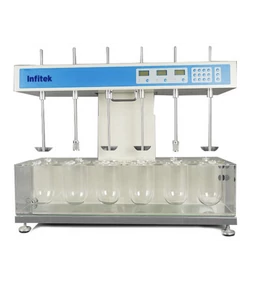
For certain active substances and food supplements, it is essential that their release is programmed. Very often, the aim is to have a delayed release rather than an immediate release - this is the purpose of extended-release, or 'sustained-release' products. To measure the rate of release, release testing devices are used. Such tests are now available at Accredit Laboratories.
To prolong the release of the active substance in tablets, excipients are used in the manufacturing process to slow down the disintegration of the tablets, the release of the active substance when the tablet is placed in an aqueous medium (the digestive tract). The purpose of the so-called retardation is to ensure that the active substance is released and absorbed slowly, thus ensuring a long-lasting effect.
Vitamin C is one of the water-soluble vitamins, which is eliminated from the body relatively quickly after absorption. When taken in the form of tablets or capsules, a significant amount of the vitamin is excreted in the urine within a few hours. To ensure a constant blood level, the vitamin should either be taken several times a day or a prolonged-release product should be used.
We use the Accredit Laboratory's dissolution testing apparatus to perform dissolution testing using both the European Pharmacopoeia's official rotary paddle and rotary basket methods. Six parallel measurements are performed simultaneously during the test. After repeated sampling of the medium containing the tablets, we test the leaching cavity to determine whether leaching is indeed prolonged. This is important because in the case of sustained release products, the manufacturer/distributor must provide evidence of the release provided, if this is indicated on the product packaging or in the marketing.